
Rats

Rats in UK Homes and Gardens
Rats are adaptable rodents found in towns, cities, rural properties and commercial buildings throughout the UK.
They can contaminate food, damage buildings and services, and create health risks. They may live outdoors, within buildings or in drainage systems.
Effective control depends on identifying the species, finding where the rats are active and understanding how they access food, shelter and buildings.
This guide explains identification, infestation signs, entry routes, prevention and appropriate control.
How to Identify Rats
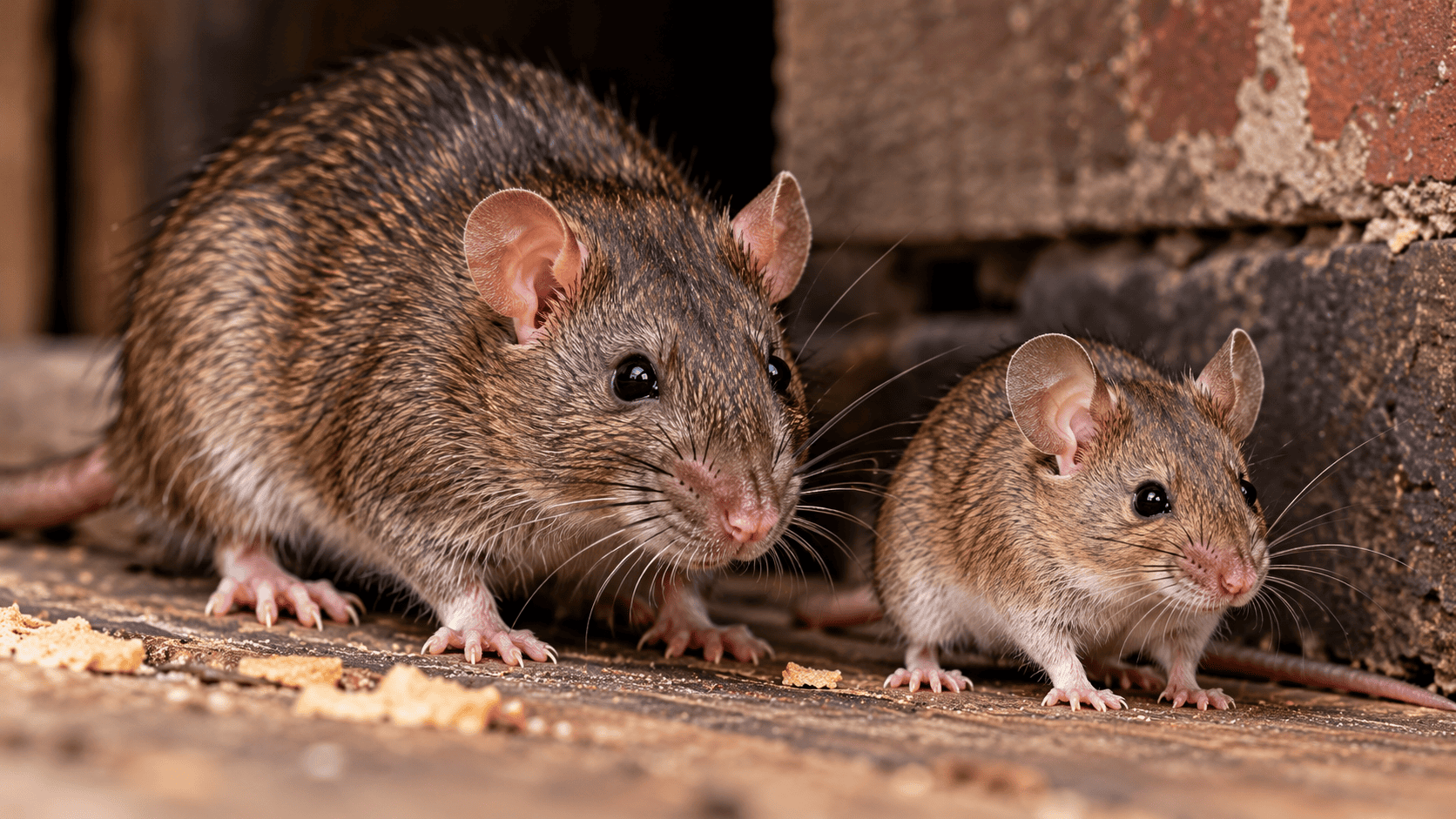
Two rat species are especially relevant to identification in the UK. The brown rat is widespread, while the black rat is much less common.
Brown Rat
Rattus norvegicusAlso called the Norway rat, this is the species most commonly encountered in UK homes, gardens, farms and sewers.
It generally has a robust body, relatively small ears and a thick, scaly tail that is usually shorter than its head-and-body length.
Fur is commonly brownish-grey, although colour varies.
Black Rat
Rattus rattusAlso called the roof rat or ship rat, this species is now uncommon in much of the UK.
It tends to have a more slender build, relatively prominent ears and a tail usually longer than its head-and-body length.
Black rats are capable climbers, but climbing ability alone is not sufficient to identify a species.
Do not identify a rat solely by its colour or the location where it was seen. Body proportions, tail length, ears and other features are more informative.
Rat or Mouse: What's the Difference?
Young rats are sometimes mistaken for adult mice. The following features can help distinguish them.
| Feature | Brown Rat | House Mouse |
|---|---|---|
| Build | Generally robust and heavy-bodied | Smaller and more slender |
| Head | Relatively broad with a blunter muzzle | More pointed muzzle |
| Ears | Smaller relative to head | More prominent relative to head |
| Droppings | Generally larger and thicker | Much smaller, often pointed |
| Entry gaps | Can use surprisingly small openings | Can enter through even smaller gaps |
Size alone can be misleading, particularly when comparing a juvenile rat with an adult mouse.
Signs of a Rat Infestation
Rats are often detected through physical evidence before the animals themselves are seen.
Rat Droppings
Brown rat droppings are usually dark, elongated and substantially larger than mouse droppings. Their appearance varies with diet, age and condition.
Droppings alone should not be treated as definitive species identification.
Scratching Noises
Movement may be heard in lofts, wall cavities, floors or ceilings. Noises can also be caused by mice, birds and other wildlife.
Burrows and Runs
Brown rats frequently establish burrows near sheltered areas, foundations, sheds, vegetation and suitable food sources.
Avoid touching droppings or contaminated materials with bare hands. Do not dry-sweep or vacuum rodent droppings, as this can disperse contaminated particles. Follow appropriate cleaning and disinfection guidance.
How Rats Get Into Houses
Rats exploit weaknesses in building construction and maintenance. Some entry points are obvious, but others are concealed beneath floors, behind units or within drainage systems.
External Walls and Foundations
Gaps around service pipes, damaged brickwork, broken air bricks and openings near foundations can provide access.
Drains and Sewers
Defective underground drainage, open pipework and damaged connections can provide routes into subfloor spaces or buildings.
Roofs and Loft Spaces
Rats can climb rough surfaces, pipes and vegetation. Damaged roof details and service openings may allow entry.
Floors and Internal Voids
Once inside a structure, rats may travel through service ducts, floor voids, wall cavities and other connected spaces.
Catching or poisoning rats may reduce activity temporarily, but new animals can enter if the underlying access route remains open.
Can Rats Come Through Drains?
Yes. Brown rats are capable swimmers and commonly inhabit sewer systems. Defects in drainage infrastructure can sometimes provide a route towards buildings.
Possible problems include fractured pipes, displaced joints, defective connections, redundant drains and damaged inspection chambers.
When might a CCTV drain survey help?
- Rats repeatedly return despite previous control work.
- Activity is concentrated beneath floors or near drains.
- External entry points cannot explain the infestation.
- There is evidence of defective or redundant drainage.
A CCTV drain survey can help identify visible structural defects and possible routes, but it does not automatically prove that rats are using a particular defect.
Rat-resistant drainage devices can be useful in suitable installations, but they are not a substitute for repairing defective pipework. Any device must be appropriate for the drainage system and maintained as required.
Are Rats Dangerous?
Rats can create health and property risks, particularly when they enter food-handling areas or occupy buildings.
Disease and Contamination
Rat urine, droppings and contaminated environments may expose people to infectious organisms, including those associated with leptospirosis.
Property Damage
Gnawing can damage insulation, wood, plastic pipes and electrical wiring, potentially creating costly or hazardous defects.
People working around drains, floodwater or heavily contaminated environments should take particular care.
Seek prompt medical advice following a rat bite or if you become unwell after possible exposure to contaminated water or rodent waste. Explain the exposure to the clinician.
How to Get Rid of Rats
Effective rat management combines inspection, removal of food and shelter, appropriate control, entry-point investigation and proofing.
Identify the Problem
Confirm rat activity, establish the likely extent of the problem and inspect affected areas.
Investigate Entry Routes
Check building defects, service penetrations, drains and connected voids.
Control and Proof
Use suitable control methods, remove attractants and close confirmed access routes at the appropriate stage.
Trapping
Properly selected and positioned traps can form part of rat control. They must be used in accordance with relevant UK animal-welfare requirements and protected from access by children, pets and non-target wildlife.
Rodenticides
Rodenticides may be appropriate in certain circumstances, but their use involves risks to people, pets and wildlife. Products must be authorised for their intended use and applied strictly according to their labels.
Professional assessment is advisable where infestation is extensive, persistent or difficult to access.
Proofing
Durable proofing involves identifying and repairing the actual access routes. Suitable materials and methods depend on the structure and location.
When rats keep returning, don't simply repeat the same treatment without investigating why. The important question is whether the property still provides access, food or shelter.
Why Rat Problems Keep Returning
Recurring rat activity often indicates that the underlying conditions have not been fully resolved.
A fresh investigation may reveal that rats are using a different route from the one originally suspected.
How to Prevent Rats
Prevention focuses on making buildings and outdoor spaces less accessible and less attractive to rodents.
Never block an opening without considering whether animals are trapped inside the structure. An appropriate control and proofing plan should address this risk.
Frequently Asked Questions
Can rats climb walls?
Yes. Rats can climb many rough surfaces, pipes and other structures. Their climbing ability depends on the surface and available footholds.
Can rats come through toilets?
It is possible, although unusual. Rats can travel through drainage systems under certain conditions. A suspected drainage problem should be professionally investigated.
Does seeing one rat mean an infestation?
Not necessarily. A single sighting could involve a passing animal, but further inspection is sensible, particularly if other signs are present.
Are rats active during the day?
Yes. Although often predominantly nocturnal, rats may be seen in daylight. Daytime activity alone does not prove a severe infestation.
Will poison stop rats returning?
Rodenticides may reduce a rat population, but they do not repair building defects or prevent new animals entering through existing routes.
Can rats live beneath floors?
Yes. Accessible subfloor spaces can provide shelter and routes through a building, particularly where there are openings or drainage defects.
Do rats chew through concrete?
Rats can gnaw some softer building materials and exploit existing weaknesses. Sound, properly constructed concrete is generally resistant to rat gnawing.
When should I call a professional?
Professional help is advisable when rats are inside a building, activity continues, access routes are unclear, or safe control cannot be carried out.